It took me 45 Years to Realize What I'll Tell You in 14 Minutes.
August 23, 2026
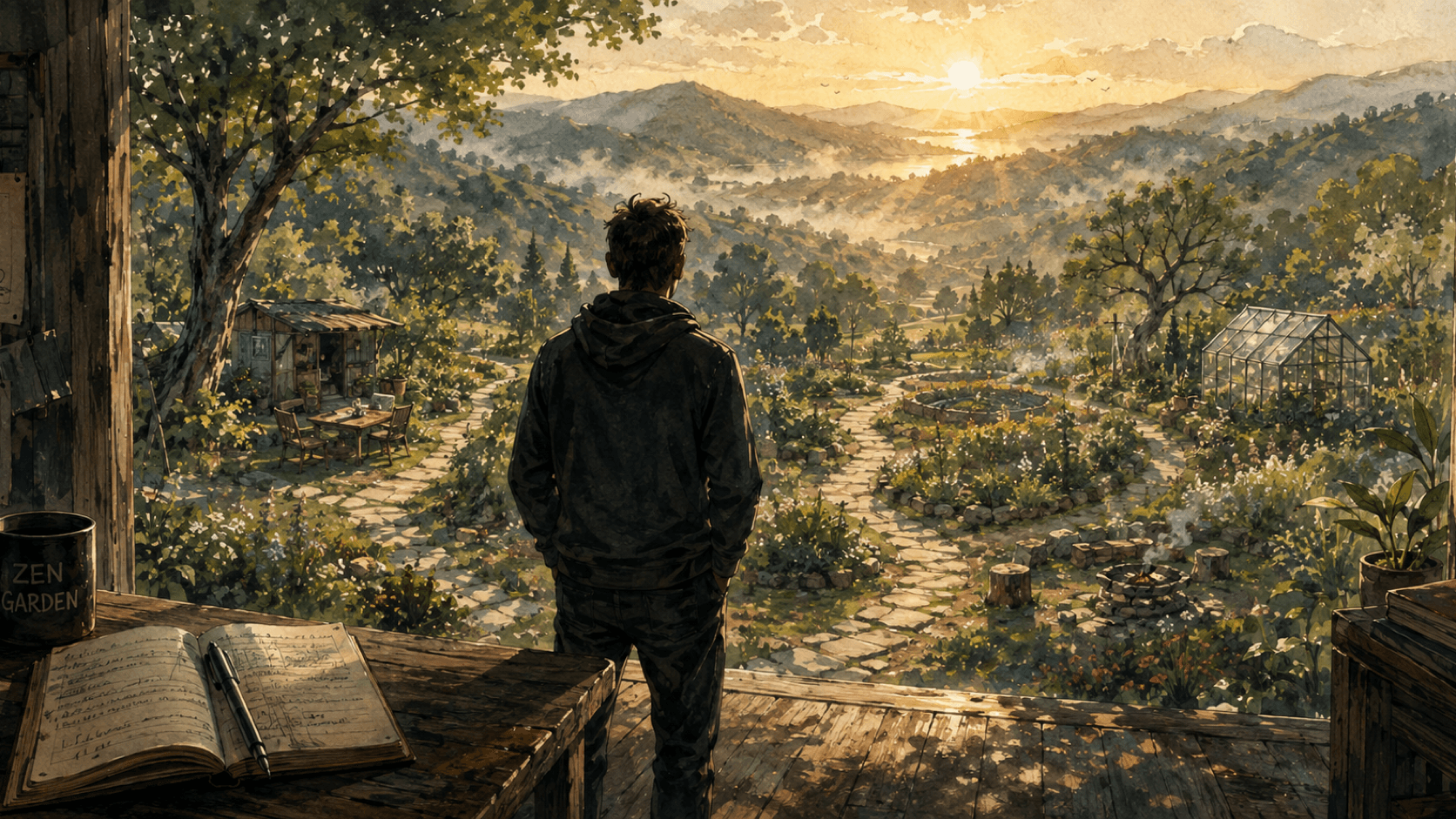
What if your mission isn't waiting to be found — but waiting to be seen?
Last week I told you who I am. The two moments that prepared the soil for everything I do today. A place, connected to an unshakeable trust, that I return to again and again. I call it Zengarden.
Having a place like this — somewhere you can return to, refuel, rest, and get inspired, independent and free from external circumstances and noise — is pure gold.
Today I'll show you what has grown there since. And why I'm here. And what for.
Everything I do follows an inner attitude.
In Tibetan Buddhism, motivation and dedication are the essential bookends of every spiritual practice. And for me, every second of my life is spiritual practice. I don't separate life from practice.
The saying goes:
I do this not for my own ego, but so that I become wiser and more compassionate, to be of use to others.
During "practice" — in my case, writing — I check: Am I still connected to the mission or have I strayed? Is it ego-driven or does it come from the Zengarden, to stay in my image.
So every action becomes meditation. Whatever you do: writing, eating, taking your kids to school, gardening. Whatever it is.
That's the place we're starting from.
The Roots
We saw in last week's letter that I was flat on my face at a young age and had to learn my lessons in life. Life humbled me. And softened me. Even though I was already asking questions and was curious before the breakdown at 19 — the collapse into psychosis — my excessive lifestyle had completely clouded my mind. That breakdown changed everything. I suddenly developed a deep connection to something "Greater." Many call it God. I've always called it Life.
From that moment on, I asked myself: "OK, Life, why am I here? What should I do?"
After 1989, I entered one path after another. And with each one I thought: "Ah, THIS is it. This is my mission."
- Disability care at 19 → "I want to support people."
- A store turning over €500,000 at 30 → "I want to build something that holds."
- Therapy training (Gestalt, NLP, Systemic) at 38 → "I want to heal people."
- Gestalt therapy practice at 40 → "This is really it now."
- Outdoor educator at 50 → "In nature, with young people — this is it."
- Coaching (OUTJOY) at 54 → "Now I've got it."
Every one of these paths was right at the time. And every one was sincere. At the same time, looking back, every one was a misinterpretation. I thought every path had to be the whole answer.
In truth, every path was part of the garden. And the garden could only appear when I stopped looking for one path and started seeing them all together.
I walked through this garden for 45 years. And the same thing kept happening: a spot would pull my full attention. I wouldn't just stop and look. I'd start digging. I'd build a completely new bed right there. Put a fence around it. Lay paths. Build a greenhouse. I created a garden within the garden.
And while I was building, I forgot the bigger garden still existed.
Sogyal Rinpoche said something that burned itself into me:
"What is so important that we forget what's most important?"
For me, every one of those phases was exactly that: an area of the garden that became so important the whole garden disappeared behind it.
Disability care at 19: a whole bed, lovingly planted, watered every day. The store at 30: a greenhouse that took over the entire yard. Gestalt training at 38: a tree that overgrew everything. Outdoor educator at 50: a wildflower field I mistook for the whole world.
Always with full devotion. Always thinking: This is it. This is the garden.
Eventually, after years, I stepped back and saw: Wait — I'd been in the garden the whole time.
Here, the beds I'd forgotten. The paths connecting the areas that I never finished walking. Plants that had grown without me.
Every area belonged. None was wrong. But none was the whole garden.
The last bed I planted was called OUTJOY. It flowered until this summer. And then, for the first time, I saw the whole garden.
The Summer I Saw the Whole Garden
At the end of July, I sold my beloved 50-year-old Mercedes truck — which I called Haubi (short for Kurzhauber, a short-nosed truck). For 10 years it was my home.
I've always loved writing. Even in the Haubi. Just for myself. Every day. The Artist's Way. Morning Pages.
After the Haubi was sold and all my focus energy was freed, it suddenly became clear: I write regularly now — and I publish too. Once a week. And I started thinking about myself, the world, who might read it — my themes and my mission.
The sale let me step back from my garden so far that I saw the whole. Full of wonder and humility, I walked through the garden and saw all these areas: the old tree, the greenhouse, the wildflowers. And I knew: I'm home. I created all of this in my life.
It took me 45 years to understand what I'd been doing all along.
And now that I see the whole garden, I can say what it is: The source of my inspiration, creativity, and power to create.
What I Hadn't Seen All Along
From all the areas of my garden — and from what had always been there — one thing becomes clear:
I help people recognize the invisible forces that keep them from living their own lives, and develop the awareness and agency to choose for themselves.
Concretely, that means:
- Helping people pause when the world says: keep going!
- Reminding people to distinguish "I have to" from "I choose."
- Helping people notice their own patterns.
I check this mission daily. Is what I'm writing right now coming from the Zengarden or from the ego? Am I acting from connection, or am I already building another bed that swallows the whole garden?
The Buddhist bookend is not decoration. It's the tool I use to ask myself: Is this bed or garden?
What the Bed Sellers Won't Tell You
When I look at the market — and at my own life — I feel like Siddhartha.
Wandering everywhere. To the Samanas, to Gotama, to Kamala, to Vasudeva. Knocked on every door. And behind every door they told him: Come in, I'll explain how it works.
I know that feeling. I stood at similar doors.
A. The Frameworkers say: Apply this and it'll work. Here, 5 steps. 3 buckets. 9 habits. The system. Works for everyone. Guarantee included. B. The Answerers say: One thing, found correctly, solves everything. Find your Why. Unlock your potential. Your purpose as the holy grail — you just have to discover it.
I was in all those rooms. Learned methods. Applied systems. And thought: This is it.
What I found: Not the one door. But the realization that I don't need to knock on any door at all.
A mission that sounds like everyone else's mission is not a mission. It's a category.
That's why I'm not offering a catalog of beds. I'm opening a garden.
The difference?
- Add vs. Remove. The bed sellers say: Add. I say: What do you need to let go of? Transition always starts with an ending.
- Concept vs. Attitude. The bed sellers say: Do it this way. I say: Look. Then you decide.
- More vs. Clearer. The bed seller turns up the volume. I turn up the presence.
- Guru vs. Counterpart. The bed seller has the overview. I have an empty chair.
- Found once vs. Checked daily. The bed seller hangs their mission over the desk. I ask myself a question every morning.
- Universal vs. Personally tested. The bed seller says: Works for everyone. I say: Here's what worked for me. Your path looks different.
And Still, I'm Giving You a Map
Here's the uncomfortable paradox. I'm fully aware: As humans, we don't escape this contradiction. I'm showing up with a concept myself. With a map.
Pause. Notice. Choose. Arrive.
Four steps. A framework. Exactly what I just argued against.
But here's my take on it:
I didn't copy this concept from a bestseller. I found it over 45 years. Not in a training. Not in a book. On the floor of my living room at 4 a.m. when nothing worked anymore. In my truck at a rest stop. After every failed bed, when I stepped back and saw the whole garden again.
I lived every one of these four steps. Not as theory. As necessity.
I'm not giving it to you as the solution. But as my solution. To look at. To try. To throw away. Maybe it helps you find your own. Maybe you'll see that your steps have different names. Maybe you only need two. Maybe six.
Here's the difference: I don't claim it works for everyone. I only say: It worked for me. And the people who write to me — "What should I do?" — they're not asking for a system. They're asking for a beginning.
This framework is a beginning. Not more. Not less.
The four steps, offered as an invitation:
- Pause. Stop functioning. Stop pushing. Just stop. Open a space where everything that's there is allowed to arise. I am here. Nothing has to happen. I'm simply here. Without this step, nothing works in my world.
- Notice. Read your inner system. What still carries you? What exhausts you? What is being kept alive only because it's always worked? How do you function? Where do you fall into holes? Where are you chasing systems that aren't yours?
- Choose. Given what I now see, what do I choose? Not: What must I do? But: What do I want — in light of what I now see? A small first step. Often one insight is enough. Let something go. Recalibrate the compass.
- Arrive. Live what you've chosen. Check in. Next week, start again from the beginning.
Take it with you. The Pause Workbook. A workspace I've been using myself for years. No promise of salvation. No 5-day transformation plan. An empty room you can fill with your own things. Step in. Play with it. Make your own space out of it.
The Garden Is Waiting
This is the garden I wanted to show you. Not a bed I've planted for you. Not a system you just have to work through. Not a single answer that solves everything.
A space. Your plants. Your questions. Your pace.
I walked through this garden for 45 years, planted every bed individually, mistook each one for the whole garden. I built, gave up, started over. And somewhere along the way, I stepped back and saw: There's more. Much more. Always was.
That step back — I wish it for you too.
Not my path. Yours.
Next week, I'll show you the systems that shaped me most on my journey. What they revealed about the invisible forces that steer us — and how we keep ending up in the wrong bed without noticing.
Until then, a question that made me step back:
What is so important in your life right now that you're forgetting what's most important?
Write me. One sentence is enough.
Begin with the workbook
Receive SELF / AUTHORED — a free workbook for autonomy, awareness, and action — plus one letter a week.
Get the workbook + weekly letterWho's Writing This?
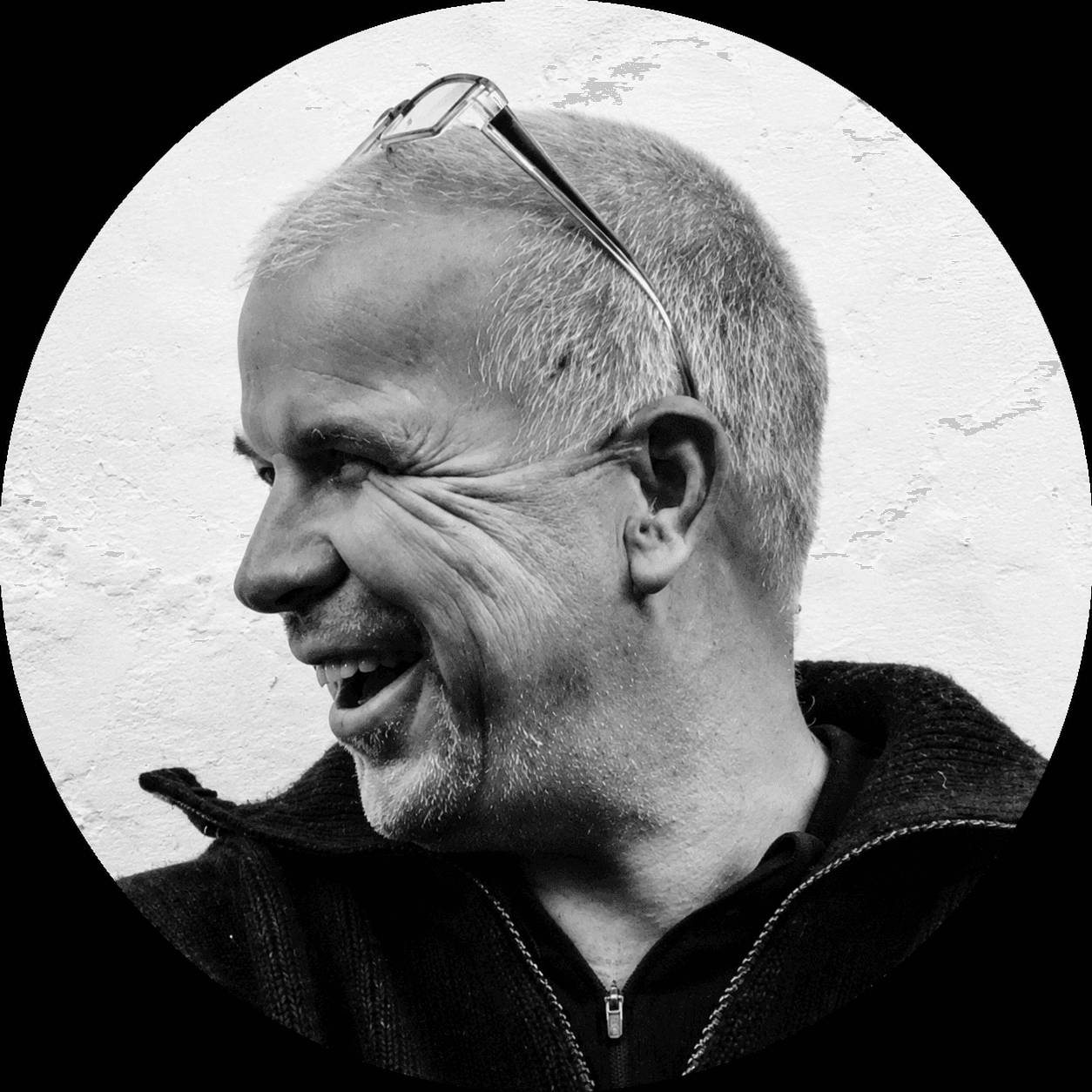
Dirk spent ten years living out of a truck, no fixed address, just whatever the work and the weather asked for. Long enough to feel exactly what it costs when your days belong to someone else's system. He's since worked outdoor education, wholesale, disability care, logistics — different rooms, same habit: read the system, name what's really running it, find where you stand in it.
Stay Near The Fire?
A weekly letter for people building their own systems instead of renting someone else's.
Join the conversation — one letter a week, in your inbox.