Lost Wallet in Da Nang – A Night That Restored My Trust in People
What happens when you lose everything for a moment — and strangers step in like family.
The Evening Begins on the Roadside
Around 5:30 p.m., I’m sitting at a plastic table by the roadside. In front of me, a cup of sugarcane juice, ice cubes clinking, motorcycles streaming past without end. I love this mix of sounds and smells: sweet juice, fried rice, a hint of gasoline.
Next to me, the family who runs the place. The mother keeps an eye on everything, the sons work the press, the daughter handles the cash, a cousin wipes tables. Under an awning: gas burners, bowls, knives; behind them, the juicer squeaks in rhythm. Right on the main road, across from the promenade, dozens of wide Vietnam-style loungers line up – metal frames with taut plastic fabric, frayed in places like old fishing nets. Between them, small plastic tables and a few stools. I place my backpack – with my wallet inside – on one of the loungers, the way many regulars do here.
The Moment of Loss
Later, back at the hostel. My hand reaches into empty air where the backpack always hangs. My chest tightens. My mind clicks instantly into that narrow, glass-clear mode. Five minutes. What to do? Back. Route, last stop, last movement. I take a sip of water, close my laptop, and ride back on the scooter – not fast, not slow, but with intent. Stephen King’s Roland from The Dark Tower. Winston Wolfe from Pulp Fiction, in a T-shirt.
The Neighborhood Moves
Back at the shop: the whole family is already on their feet. The son has hung my backpack on a hook – without the wallet. The mother’s eyes narrow. She hears two, three sentences from me and bolts like a cat. Helmet in hand, scooter on, she calls something to the son, who shrugs, doesn’t laugh, just looks serious and points to the street. A nephew pulls out his phone, two girls point left, the daughter nods. From nowhere, a collective forms. I’m in the middle – and no one looks at me like a stranger. They nod, as if I belong here.
Five women, two employees, a neighbor – all talking, searching, asking. “Money?” the daughter asks. I shrug. Of course, money. Baht and dong. But my mind is on the passport, the cards. Security system: redundant, distributed, protected. Annoying, but manageable. I take a breath and say the sentence that is also my stance: “What matters most to me is the passport.” The daughter nods, the mother is already roaring away on the scooter. An uncle calls to me: “To the police! Come!”
The Police Station
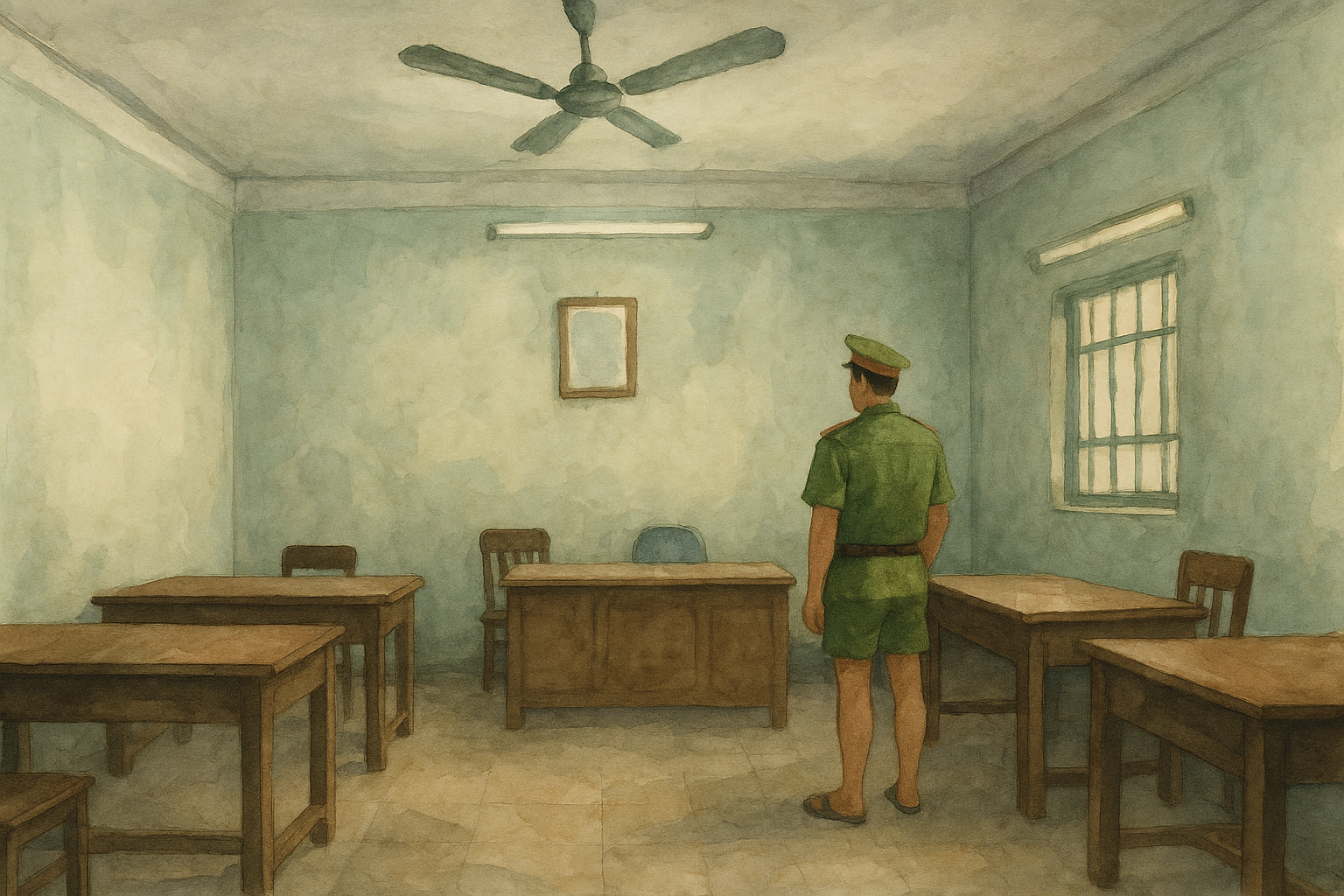
The station is barely a hundred meters away. A narrow building with a ceiling fan, the air smelling of paper, dust, and cold tea. Particleboard desks. Scuffed corners. Neon light. It feels like Polizeiruf 110 in Vietnamese – with a touch of Honecker’s office. A uniformed man in swim trunks stands at the window, stubs out a cigarette, pulls on a vest, and becomes an officer. I love moments like this: the world falls into its separate parts and still holds together.
Two officers ride back with me to the shop. The team sits down as if for a family gathering. The mother brings sugarcane juice for everyone, I hear the crack of ice cubes. One officer asks, another writes, the daughter explains, the neighbor adds details. From the conversation, a sketch emerges: two women, locals, no tourist look, at that table in the early evening. The mother is sure who. A finger points in the direction they disappeared. The officers nod, get up, and go. No siren, no noise. Just: gone.
Waiting and Witnesses
I’m back at the station. A pavilion, plastic chairs, a mattress in the back room where someone sleeps. The officer slides the door shut, we take the other room. Questions about the time, the contents, my movements. “Where was the passport?” – “In the wallet’s inside pocket, behind the bills.” – “How much money?” – I give the amount in dong. An officer raises his eyebrows, notes it slowly, as if committing it to memory. Then: waiting again.
Outside, a parallel play begins: three elderly people, agitated, bickering – a neighborhood quarrel, about noise, land, honor, who knows. I’m politely asked to step outside. I sit under the pavilion, hear voices, look into the open courtyard. The scene carries this strange tone of order and improvisation. No ticket system here, no machines, no overflowing trash can. Here, people talk.
The Return of the Wallet
I stay calm. No shaking, no tunnel vision. My body knows pressure; it has trained for years, weathered storms. I scan inwardly: breathing. Heart. Hunger. Water. I recall the map: Revolut. Scooter rental. One call and cash flows again. The day leaves room to maneuver. No danger to life, just a tight curve. Enough to stay centered.
The door opens. A group enters the courtyard: two women, one man, one officer. I lift my head and, for a moment, think I see my wallet. A flat, dark shape – the kind I recognize. I don’t stand up, don’t cling to anything, just let my gaze rest. Then the group disappears into the office.
Minutes later, movement. Shouts, a quick burst, then silence. An officer waves me in. On the table lies my wallet. The passport in its place, cards, papers, everything intact, the dong compartment almost empty. 448,000 remain like a pile of crumbs. The large bills are gone. The officer looks at me, the mother’s lips are thin, one of the women sits with glassy eyes in a chair. She forces out a “Sorry,” the other scolds, a man raises his hands to calm things.
Justice, Not Blood
Five, six, seven officers stand around the table. A line of bodies saying without many words: We’re on it. And yet evidence is another breed. A scooter’s helmet compartment rarely locks. Anyone can put something in. Cameras? None. Open space, open systems. The mother swears she saw them. The police nod, confer, speak quietly, write. I sit there like in a theater where the stage brings forth people, not paragraphs.
Now a new question rolls my way: “Do you want us to proceed according to law?” Arrest, investigation, paperwork? Or an ending on the short road – a warning, a social consequence in the neighborhood, without a thick file? I breathe. I want justice, not blood. I want dignity, not a fight. My gut says: truth and dignity can exist without a fine. My head says: if the system wants to work, I won’t stand in its way. So I say, in simple words: Keep investigating. I’ll leave the wallet here if it helps. Let me know if there’s news.
A Circle of Care
The hostel owner sits next to me. He translates through an app, types sentences, holds up the phone. His face shows fatigue and loyalty in one. He apologizes again and again. For the noise, for the fuzziness, for the trouble. I squeeze his arm: he has done more today than some good friends. He stayed. He explained. He brought me, fetched tea, stayed again. That’s lived closeness.
The officers shift roles. The strict tone gives way to a calm, almost Buddhist circle. Heads together, eyes on the wallet, questions about the position of the bills, the sequence, the time. One in a muscle shirt, one with uniform buttons, two in plain clothes. The sleeper in the next room rolls over, the fan rattles. This mix of improv policing and deep human responsibility moves me. No one here processes a ticket number. Here, a group carries the dignity of a guest.
Warmth Instead of Perfection
After midnight it’s clear: this won’t end like a courtroom drama. It will end like a neighborhood day in a big city. No cameras, no unbroken chain of evidence, no signed statement of guilt. I sign one line that sums up the night: documents recovered, money missing, investigation ongoing. The officers drop their shoulders as if setting down a heavy box. The mother shakes my hand. The hostel man exhales. So do I.
On the way back to my room, I’m carried by a strange mix: relief, fatigue, gratitude. I think of the East German images that crossed my mind: the particleboard desk, the neon tube, the resolute “We’ll get this done” – not as a slogan, but as a stance. I think of Polizeiruf with scooters instead of Ladas, swim trunks under the uniform, a back room with a mattress. All of it feels anachronistic and yet vividly alive. No forest of forms, no cold shrug. Instead, a family that feels responsible, a mother who roars like a lioness, a police force that drinks tea and still gets moving.
What Remains
What remains? A wallet that breathes again. The passport, that small paper world. Cards still working. Money gone. Tuition paid. And an evening that says more about warmth than any brochure. In Germany, I once experienced break-ins – a file, a shrug. Here, a tear becomes a circle. A neighborhood moves. People become threads in a net that holds. The neighbor with the scooter, the mother with the gaze, the daughter with the questions, the uncle who nods, the officers who shift pressure like pauses in a song. It feels like a village writing its own story.
And me? I sit on the bed and look at the passport as if holding a found photograph. I have the energy to laugh. The day had cinema, slapstick, drama, stillness. I see myself in the pavilion, counting my breaths. I hear again the sentence in me: “I solve problems.” Not because I love them, but because solutions make me calm. And I feel: I have a muscle for trust that works hard now. I trust in systems that tick differently than mine. I trust in people who show who they are without words. I trust in myself, in this sober, clear mode that keeps me able to act.
The Morning After
The next morning, I walk along the beach. The air salty, the light soft. I see the city, the skyline, the open water. I think of Tel Aviv, Aqaba, Eilat – places with similar images and yet entirely different. Lines form in my head between these points. Every journey lays another track. That helps in moments like yesterday. The more often you land, the softer the landing.
I stop and lay out the evening’s chronology like photos on a table:
- The loungers at the restaurant.
- The empty space in the hostel.
- The mother’s roaring scooter.
- The pavilion in the courtyard.
- The man in swim trunks with the uniform vest.
- The mattress in the back room.
- Sugarcane juice for the cops.
- Two women, one scooter, one helmet compartment.
- My wallet on the table.
- 448,000 like breadcrumbs.
- A question you can only answer with stance.
- A host who stayed.
- A neighborhood that doesn’t look away.
I smile. Money returns. Time never does. What remains are sentences and glances. The mother who doesn’t let anyone leave who wrongs her house. The officer in swim trunks because service here isn’t a costume, it’s presence. The host who doesn’t go home though the night hangs heavy. And me, sitting down to write. East German nostalgia meets Vietnamese present. Particleboard meets sugarcane. And in the middle, a lesson I write on the inside of my hand: trust is not weakness. Trust is a tool. With trust, you build bridges over rivers with no railing.
In the evening, I fold the wallet open and closed. The passport still smells of office. I picture it in that helmet compartment, like a message in a bottle. Someone put it there, someone took it out again. In between stood people who acted. I need nothing more than truth. The world remains illogical and warm. Together, they make a home for a while.
I place the passport on the table, drink tea scented with kumquat, and write the last line of the day in my notes: “Warmth beats perfection.” Da Nang showed me that yesterday – staged with plastic chairs, fans, and open doors. Doors that don’t lock because people see each other. Doors through which you can look into living rooms, onto hammocks, TVs, children sitting on scooters. Life that doesn’t hide. A neighborhood that puts the stranger in the center when it matters.
I turn off the light. The rattle of scooters stays outside, the quiet inside. Tomorrow I’ll make my rounds again, drink a salted coffee with condensed milk, maybe a green tea after. And I’ll greet the mother, the sons, the daughter, the uncle. Maybe we’ll share a short laugh. Maybe the mother will say just one word that says it all: “Seen.” And I’ll answer with a word that fits every language: “Thank you.”