You Never Finish Anything? You're Not a Quitter — You're a Conductor.
August 30, 2026
What makes me different from others — and why my path might show you that nothing is missing in you.
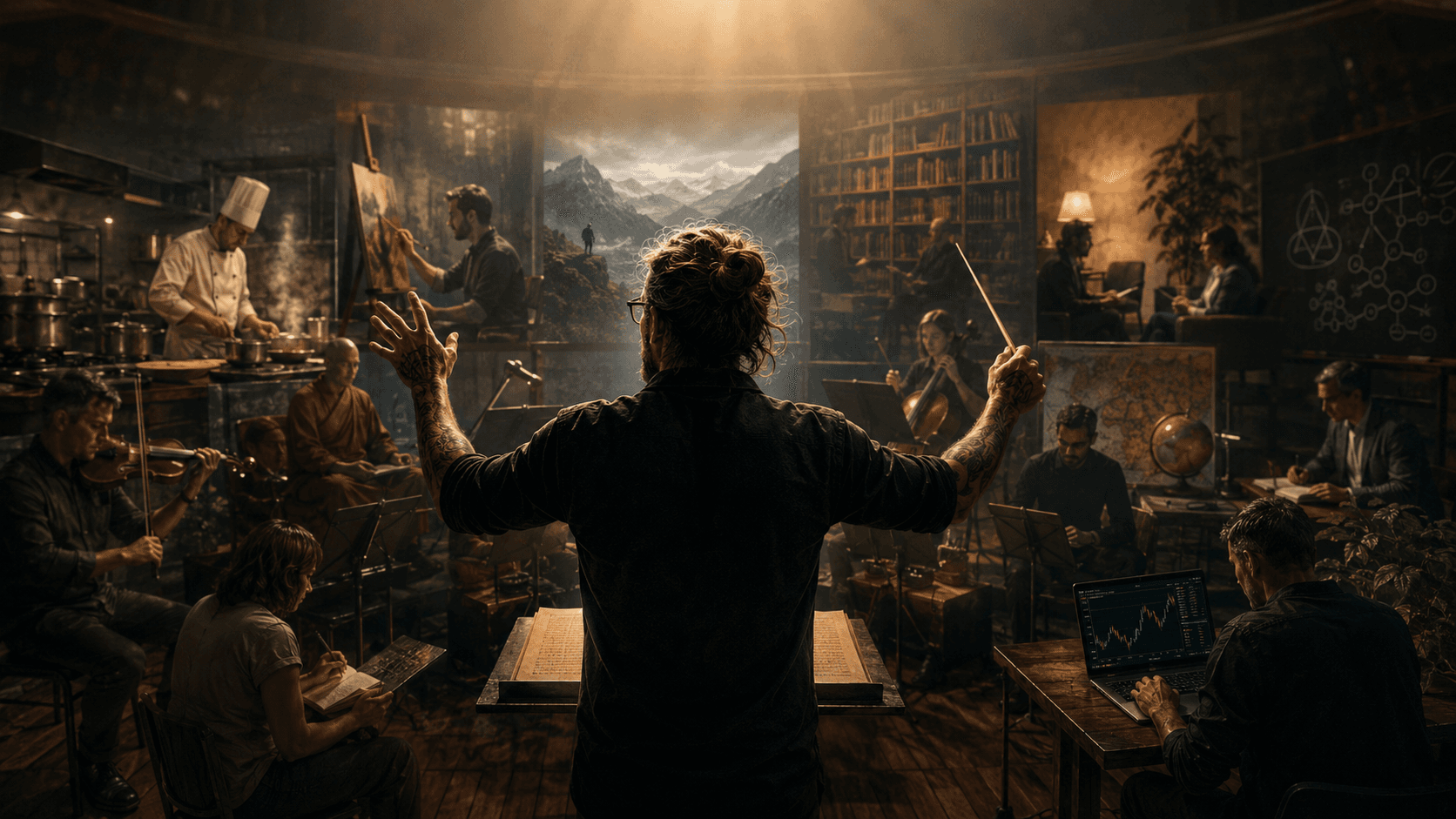
Part 3 of a series "About Me." After Part 2 gave you a sense of my mission, today is about what sets me apart from others.
I've spent most of my life walking into other people's worlds. Simply because I was fucking curious and still am. Like a dog that's picked up a scent and won't rest until it knows where it leads.
As a kid I tried everything: sports, musical instruments, whatever grabbed me at the time.
Table tennis was interesting until I understood how the game works: ball there, ball back, win. Okay, got it. But now what?
I wanted to know why people do things, what the core of it is, why they play this game at all, whether it makes them happy — and above all, what lies outside the playing field.
I asked myself: "Ah, you're supposed to win. And what for? What comes next? Win again?"
This pattern has followed me through my entire life: Psychology, therapy, systemics, NLP, Gestalt, Buddhism, Design. Art, Culinary, Meditation, Advaita, Satsangs, Business, Money, Bitcoin, Relationships, Nature, Travel, Creativity and more.
I didn't look at these worlds from the outside. I went inside. I learned their content and patterns. I immersed myself in them.
And no, that doesn't make me an expert in all these things — that would be absurd. In every single field there are people who have gone much deeper than I have. But I've spent enough time in these kitchens to know their taste.
At 17 I started a cooking apprenticeship. And not just anywhere in some small pub, but in a five-star hotel.
I was right in the middle of that world: in the kitchen, in the rhythm, in the hierarchy, in the rules, in the standards, in the whole damn system. Michelin-star kitchens in the 80s were rough.
I learned how a kitchen at that level works, and I took the craft seriously and learned a lot.
And at the same time I noticed pretty quickly that this system and my reality at the time didn't harmonize. The rules were clear. The hierarchy was clear. Everyone had their place, their station, their job.
The system knew exactly how a chef was supposed to function. You go along or you go under. I couldn't do it.
I didn't become a Michelin-star chef. And I would never claim to be one. But I know what that kitchen feels like.
I know the smell, the noise, the pressure, the hierarchy, the craft and the taste.
I've sat at the table and I've been in the kitchen. I've drunk the wine, slurped the oysters and watched how they end up on the plate at the same time.
I don't need to spend twenty years perfecting the same sauce to know it's good.
That's maybe the best metaphor for my whole path.
I've walked into many kitchens. I've learned the recipes, tasted the ingredients and immersed myself completely in the kitchen often enough.
Some dishes I loved. Some chefs I admired. Deep connections formed. Some kitchens were my home for a long time.
But at some point I wanted to know what's cooking in the kitchen next door. And above all, I wanted to understand what all these kitchens have in common.
That's exactly why I didn't become an expert in a single field. Other people are here for that. There are people who spend their whole lives perfecting a single sauce, and who see and taste things in it that I will never see or taste. I respect and admire that.
For most people, expertise means going deeper and deeper into a single area.
For me, going deeper eventually also meant reaching the edge of that area and getting curious about what lies beyond.
I didn't just want to collect disciplines. I wanted to understand what connects them. What does a therapist see that an economist might not see?
What does a Buddhist understand about attention that a business strategist misses?
What can systems theory tell us about a relationship?
What does Bitcoin say about dependence and sovereignty?
Why do the same fundamental questions keep appearing in completely different fields?
From the outside, my life can therefore look pretty chaotic.
A lot of stations. A lot of interests. A lot of things that seemingly have nothing to do with each other.
From the inside, it doesn't feel chaotic at all.
There was always a red thread.
I wanted to understand how people work, how systems work, how I myself work, and what happens when we stop unconsciously living in structures we never consciously chose.
The topics change. The question underneath has remained remarkably constant.
And then comes the part that is easy to romanticize in hindsight. Because I didn't just explore systems. I got lost in them.
Every few years I found something that felt like the answer.
This is it. This explains it. This is where I belong.
And because I take things seriously when I commit to them, I don't stand at the door, take a quick look and leave again.
I go in. I learn the rules. I give myself over to it. I invest my time, my energy and eventually my identity.
I fell in love with almost every world I entered.
Whether cooking, violin, outdoor, therapy or any of the other fields:
I don't just try them out. I inhabit them.
I go all in, learn the patterns, build relationships and make them my world for a while.
That's exactly why letting go was never easy.
When I eventually had to leave them, I didn't just switch hobbies.
I had to say goodbye to something that truly meant something to me.
Because at some point that moment came again: The system became too small for the questions I was now asking.
From the outside it might look like a simple "Doesn't fit anymore, so moving on."
It wasn't like that.
I had to learn to love something completely and still let it go, without devaluing it in the process.
Every goodbye cost something, but it also gave me insight:
a new perspective, another experience, another piece of the picture.
Only over time did I begin to understand that the individual worlds were not separate destinations, but parts of the same landscape.
Back then, I didn't see it that way though.
What came first was often something entirely different:
Fuck. Screwed up again.
You failed again.
You're quitting something again.
What's wrong with you?
You're clearly incapable of staying anywhere and just seeing something through.
And when the next world appeared, I didn't just think I wanted to learn something.
I also thought something was still missing in me.
Another book. Another teacher. Another training. Another experience. Another model.
I felt like I was still missing 36 more aspects before I would finally figure out what was actually wrong with me.
At some point life itself seemed to say to me:
Dirk, that's enough. We've gathered enough. You can stop searching for everything outside. Now it's your turn. - Life
And this is exactly where I stand today.
Not that there's nothing left to learn — there will always be a new book, a new person, a new experience, a new idea that adds another nuance to the whole.
But the ingredients are there. The kitchen is there. I've tasted enough.
Now I get to cook.
I think that's the biggest difference between the person I once was and the person I am today:
I've gone from player to conductor.
I try to bring the different worlds into conversation with each other.
Psychology is an instrument. Philosophy is an instrument. Spirituality is an instrument. Systems thinking is an instrument. Economics is an instrument. Personal experience is an instrument. Even my mistakes are instruments.
And just like a conductor, I don't need to play any of these instruments better than the specialist who has spent their entire life mastering it.
My job is different. I hear how they sound together. I hear the faintest disharmony when something doesn't fit, when an instrument gets too loud, another disappears, or an idea works on paper but sounds wrong in real life.
I don't just hear the orchestra — I also hear the room it's playing in, and the reaction of the audience.
And when something is off, I don't sit back and admire my perception. I step in.
That's exactly why my relationship with systems is different today.
I can enter a world, learn its language and take its truth seriously without having to join it.
I can learn from a Buddhist without becoming a Buddhist. From a therapist without being a therapist. Engage with Bitcoin without turning it into a religion. Love an idea without belonging to it.
That is my work today.
Not drawing a final map, but one that is allowed to change.
To keep stopping, listening, recognizing what is really happening, making a decision and then acting on it.
I don't think I'm finished. I only think I finally have enough material to begin.
Of course more will come. A new voice, a new nuance, maybe even an entirely new melody. But I don't need to run off and look for the missing instrument anymore.
Now it's orchestrated.
And if you've come this far with me, I'll show you in the next part what you can take from this conductor for your own life.
Begin with the workbook
Receive SELF / AUTHORED — a free workbook for autonomy, awareness, and action — plus one letter a week.
Get the workbook + weekly letterWho's Writing This?
Dirk spent ten years living out of a truck, no fixed address, just whatever the work and the weather asked for. Long enough to feel exactly what it costs when your days belong to someone else's system. He's since worked outdoor education, wholesale, disability care, logistics — different rooms, same habit: read the system, name what's really running it, find where you stand in it.
Stay Near The Fire?
A weekly letter for people building their own systems instead of renting someone else's.
Join the conversation — one letter a week, in your inbox.