Sleep Score 74 %. Sufficient. Do better tomorrow.
August 9, 2026
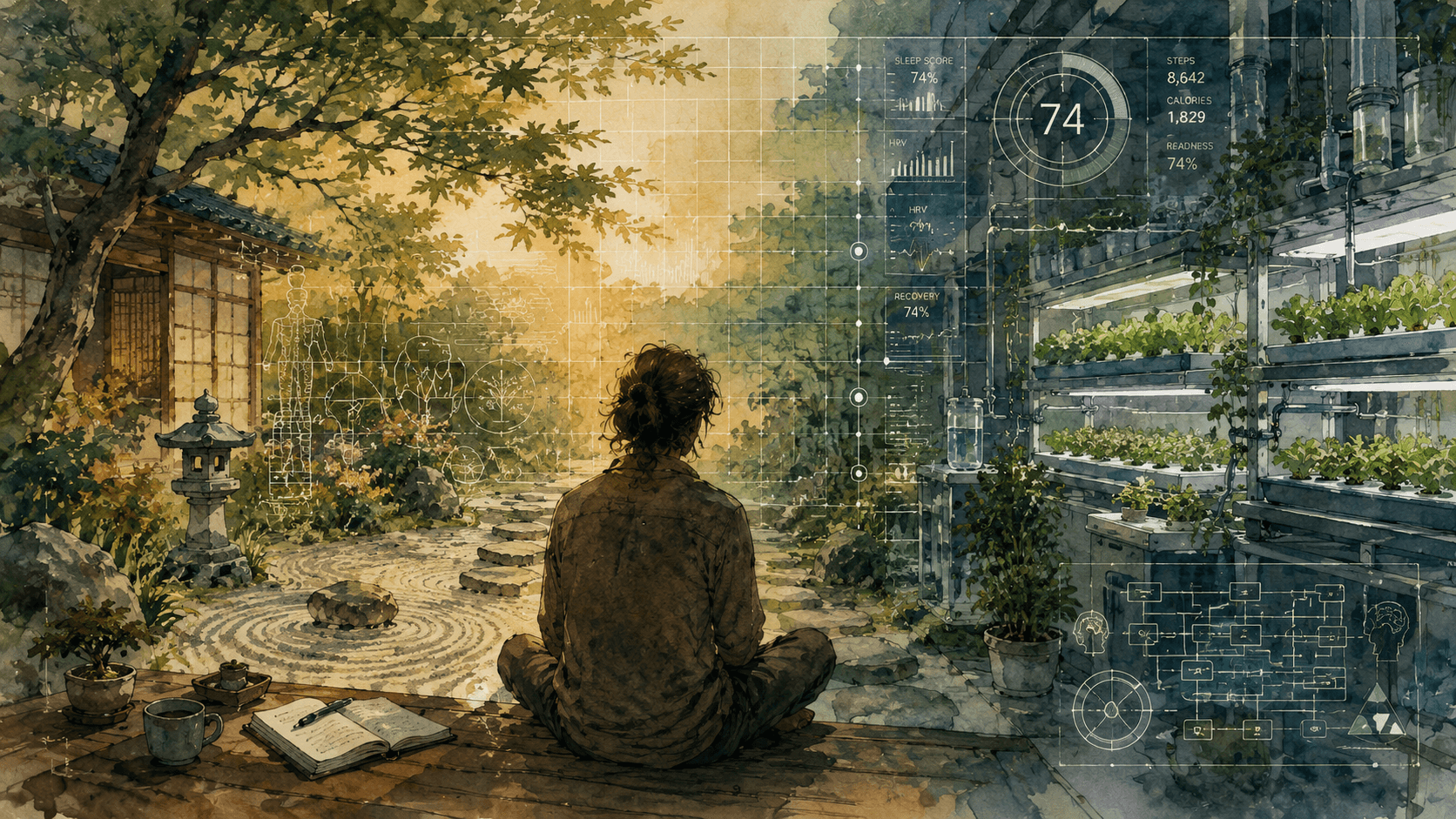
How do I even know that I'm living my life?
Years of this. Everything tracked. Everything optimized. My HRV has never been better.
Still awake at night: How do I even know that I'm living my life?
The Zen Garden and the Hydroponics Man
I keep my notes in a vault I named the Zen Garden.
Every plant watered by hand. Fragments, observations, sentences that belonged nowhere yet. I sat there in the mornings and tended it. The garden had no purpose except this: it was mine. I had built it, and I knew every path through it.
Then someone arrived with a voice full of certainty.
An AI influencer. Credible. Convincing. He said: Zen gardens are dead. What you need is hydroponics. A system run by an army of AI agents, humming like a company. More output. More efficiency. This is how you build a knowledge base now.
I felt it immediately. That familiar tightness in the solar plexus.
But alongside it, something else: a pull. Greed, maybe. Or fear. My system was no longer good enough. Everyone else was already ahead of me.
And there was this one second. A split second where I thought: Really? Is that true?
But the pull was stronger.
So I built it. Three months of energy. Three months of attention. It was laborious, and it felt productive the entire time.
Then, one morning: What am I actually doing here?
The tightness was still there. I had just stopped noticing it. The system worked, technically. But it felt like it sat outside my own inner world. I was feeding someone else's garden. Or worse: I was feeding nothing at all. I was just running the machine. Even though everything looked polished and efficient.
I had followed a voice that told me where to go. I had never asked who programmed the destination.
What We're Actually Looking For
A Substack essay made its way to me recently. What the attacks on Steven Bartlett say about a shift in our culture. Its argument: we are in the middle of a cultural shift away from perfection. After a decade of optimization, people are exhausted. Bartlett, Whoop, the relentless tracking.
For ten years, the message was: Get better. Measure yourself. Wake up at five.
Then came the counter-offer: Make mistakes. Be unfinished. Celebrate anyway.
Charli XCX's Brat Summer was the signal — an album that placed self-acceptance above self-improvement. Messiness was back.
I read it. I recognized myself in it. But something felt incomplete.
The essay frames it as optimization versus chaos. Discipline versus letting go. And I understand why this frame works so well. It is simple. It gives the reader a side to stand on.
But the fight between the two camps is the wrong fight.
Here is what the essay does not tell you: the counter-offer can become a cage too. Brat Summer celebrates disorder. The anti-optimizer wears his I am not perfect like a uniform. He chose against tracking — but did he really choose? Or did he just run in the other direction, away from one voice and into the next?
Both sides can be borrowed certainty. One says performance. The other says liberation. Both say it with the same authority. Both spare you your own question.
So the question is not: To track or not to track?
The question is not: Brat or Bartlett?
The question is: Who decides?
People also look for efficiency. But deeper down, they look for something else: orientation. We want to know: Am I living well? Am I on the right path? Is this it?
A tracker gives you an answer. A guru gives you an answer. A framework gives you an answer. And then something quiet happens: orientation becomes identity. I am the person with the perfect recovery score. I am the one who does it right.
From identity, dependence grows. A prison without a warden.
Viktor Frankl Knew This Room
Between stimulus and response there is a space. In that space is our freedom.
Frankl wrote this after surviving the camps. He knew something about what remains when everything is taken. The last freedom is not the freedom to do what you want. It is the freedom to choose your response.
But here is the problem with that space. Most of the time, it is too narrow to feel. Someone says you need this, and before your own question has even formed, you have already acted. Authority has jumped over your freedom.
I am not against tracking. I have nothing against data. I don't reject a good system.
I am against the moment when someone else's certainty arrives faster than your own question.
There is a word for this moment. It is not optimization. It is not discipline. It is something older. The Dhammapada named it in its very first verse: All experience is preceded by mind, led by mind, made by mind. What you believe becomes your reality.
The one question no tracker asks: Who told you what to believe?
Three Reasons Borrowed Certainty Wins
The mechanism is not complicated. It works the same whether you buy a Whoop or rebuild your entire knowledge system. Three things have to happen. Most of the time, they do.
One: We are tired of uncertainty.
Am I living right? is an uncomfortable question. It has no dashboard. No score. No green or red light. A tracker takes that discomfort and replaces it with a number. A guru takes it and replaces it with truth. Both feel like relief. For a while.
But relief is not an answer. And the relief wears off. Then the questions come back, only now they come at night, when the tracker is silent and the guru is asleep.
Two: It feels like progress.
This is where it gets dangerous. Building someone else's system feels exactly like building your own. The effort is real. The hours are real. The complexity is real. Your brain rewards the activity, not the direction.
In 2007, two Harvard psychologists ran a study. Eighty-four hotel maids across seven hotels. The women were physically active all day: lifting, carrying, walking miles of corridor. But two thirds of them said they got no exercise at all.
Their bodies agreed with their belief. Their weight, blood pressure, and body fat matched their perceived activity, not their actual activity.
Then the researchers told half of them: your work is exercise. You already meet the Surgeon General's recommendations. Four weeks later, without changing a single thing about their behavior, those women had lost weight. Their blood pressure had dropped. Their body fat had reduced. Their bodies had reshaped themselves around a new belief.
Your tracker does not just measure reality. It writes it.
Sleep Score 74 % is not just information. It is a verdict. And your body listens.
Three: Someone credible said it.
Not an ad. Not a stranger. Someone you trust. Someone who seems to have figured it out. A voice that says: This is how it's done now. This is what the best people do.
And the greed kicks in. Or the fear. You want to belong. You don't want to be the one who missed it. You act.
And only later, maybe months later, you notice the tightness in your chest. You notice you have become a bit duller. The system worked. You just never asked the question.
What No Score Can See
I want to be precise here. I am not against measurement. I am not against discipline. I am not against a body that works.
But there are things that cannot be optimized. A sunrise has no metrics. An encounter has no dashboard. Depth cannot be scored. Resonance arrives without a recovery report. Love has no calorie balance. Wonder burns nothing you can track.
The question is: When does a tool serve me? And when do I serve the tool?
Whether you can still hear your own question beneath the noise of everyone else's answers — that decides.
Returning to Your Own Question
This is not a protocol in seven steps. I have no system to sell you. But if you feel the tightness I am describing, here is something to try.
Day one: A morning without numbers.
Wake up. Before you look at your tracker, ask yourself: How did I sleep? Do not test yourself. Just listen. Your body knew how you slept before you ever bought a device to tell you.
Day two: A decision with a pause.
Today, when a voice says you need this, stop. Five seconds. Maybe ten. Before you act, ask: Do I need this? Do I want this? Or do I just believe I need it because someone else said so?
Not every answer will be no. But every answer should be yours.
Day three: An evening without metrics.
Make one choice today that cannot be tracked. Eat something because it tastes good. Stay up late because the conversation is right. Say yes to something that improves no score at all.
Day four: A different question at the end of the day.
Do not ask: What did I achieve today?
Ask: Did I choose today? Or was I chosen?
The Campfire
I picture a fire. Two people. Neither of them brought a tracker.
The flames do not ask for your recovery score. The night does not care about your step count. The only thing that matters is how it feels to sit next to you.
We will meet there one day.
Then I will know whether you are living your life.
Want More Letters Like This?
Every week, one letter on autonomy, awareness, and life.
Receive 1 free letter a weekWho's Writing This?
Dirk spent ten years living out of a truck, no fixed address, just whatever the work and the weather asked for. Long enough to feel exactly what it costs when your days belong to someone else's system. He's since worked outdoor education, wholesale, disability care, logistics — different rooms, same habit: read the system, name what's really running it, find where you stand in it.
Stay Near The Fire?
A weekly letter for people building their own systems instead of renting someone else's.
Join the conversation — one letter a week, in your inbox.