Who Is Looking?
June 17, 2026
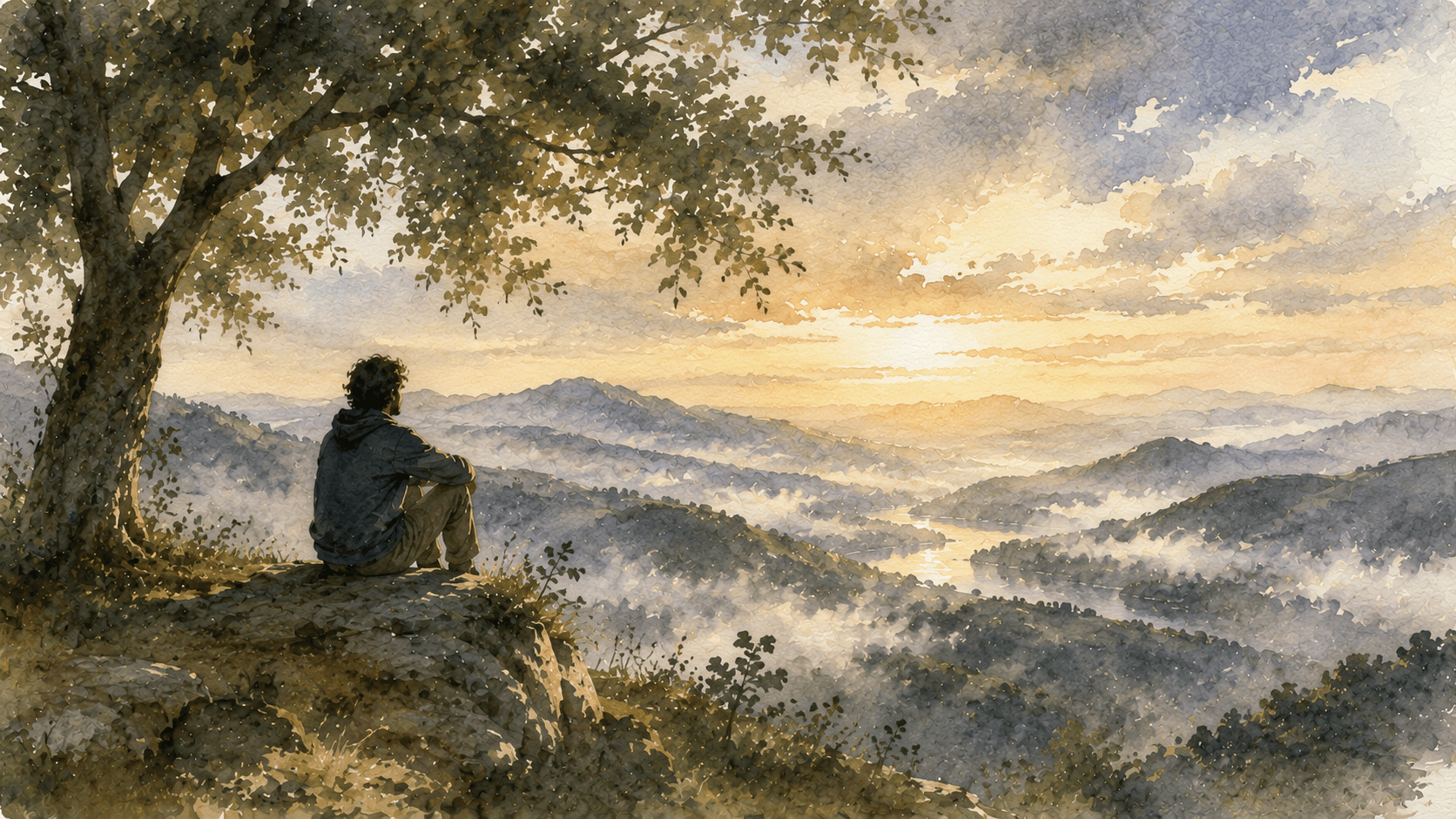
When I leave the campsite, the thermometer on my phone reads thirty-one degrees. The number doesn't surprise me. What surprises me is that the air feels even heavier than that. Over the fields lies that faint shimmer you usually only see rising off hot asphalt. The sun has disappeared behind a thin layer of cloud, but the heat has taken no notice. If anything, it has settled in more completely. It hangs between the trees, over the meadows, on the gravel path. Everything looks dry. So dry you get the feeling a single spark would be enough and the landscape would go up in flames. A light wind stirs the leaves at the side of the road, but it brings no real relief. It only reminds you that the air is still moving at all.
The Loire is behind me now. I can't see it from here. The river lies lower in the valley, hidden behind trees and embankments. The path doesn't follow the bank; it leads away from the water at a right angle, out into the fields and then into the village. When I turn around one more time, I see the pitch where I spent the night. Yesterday several vehicles were parked there. Today almost none. The hippie bus is gone. The other campers too. Only the white panel van is still standing exactly where it stood before. Since I arrived, I haven't seen anyone get in or out. Someone might live in it. Someone might not. It's one of those small riddles that come with being on the road: never resolved, and yet they produce a strange kind of familiarity.
The road rises gently. Fields to the left, their stalks barely moving. Single houses to the right with shutters closed. Nothing looks abandoned, but much of it looks as if time has slowed down here. The gardens are tended, the walls still stand straight, the roofs hold. And yet there is a quiet weariness over everything. As if the village has decided to stop hurrying. I walk slowly. Not from any deliberate awareness. Not from some practice. The heat simply doesn't allow any other pace. Each step seems to take a little longer than it would anywhere else.
When I reach the first houses of the village, the feeling intensifies. The small bakery is closed. The shop window of another business stands empty. On some facades the paint is peeling. It isn't dramatic decay. More a kind of slow disappearing. The kind of change you only notice when you haven't been somewhere for many years. There may once have been people sitting on the steps here. Children running across the square. Doors standing open, the voices of residents mixing with the sound of the church bell. Today I hear only the hum of insects and the distant sound of a tractor somewhere behind the fields.
Walking through the empty streets, a memory surfaces without warning. Vietnam. A roadside in Da Nang. Scooters moving through the city like an endless current. The constant horns. The heat. People on small plastic stools in front of street kitchens. The clatter of dishes. The hiss of a wok. The smell of grilled meat, petrol, and tropical rain. I remember intersections where more people passed in a few seconds than would pass through here in an entire afternoon. Markets still full of life late at night. Alleyways that never really fell quiet.
For a moment both places appear at the same time in my mind. The small French village and the Vietnamese city. The differences couldn't be greater. Empty streets there, crowds here. Closed shutters there, shops open until late here. The hum of insects there, the hum of engines here. And yet I feel no contradiction. The longer I think about it, the more familiar this apparent opposition becomes. Because if I'm honest: at both places I felt remarkably similar.
That may be the strangest thing about this afternoon. For a long time I thought my sense of well-being depended on external circumstances. The right surroundings. The right landscape. The right country. Somewhere that place had to exist where everything fit together. A place where you finally arrived. A place where no tension remained between the possibilities. But the longer I've been on the road, the less I believe that. The best moments of my life have come in completely different places. Some in silence. Some in the middle of noise. Some alone. Some surrounded by people. The more closely I look, the less the place itself seems to be the deciding factor.
I turn into a narrow side street and leave the centre of the village. Behind the last houses the landscape opens up again. The fields lie under the grey sky like a spread-out blanket. In the distance I can make out the line of trees along the Loire. From up here it looks like a green stripe cutting through the land. Somewhere down there the river keeps flowing, even though I can't see it. It occurs to me that the Loire on this afternoon feels almost like a metaphor. Invisible, and yet constantly present. Not in the foreground, and still setting the direction. There are things that escape our sight and still determine the actual course.
Walking on, I think of the many discussions of the past years. About ways of living. About freedom. About languages. About travelling. About settling. About city and country. The same search again and again for the right answer. The right decision. The right attitude. But most of those questions feel surprisingly distant today. Not because they're unimportant. Because they suddenly feel smaller. As if something deeper lies beneath them, something that none of these oppositions can touch.
That may be exactly why the memory of Vietnam occupies me so much today. Not because I want to go back. Not because I left something behind there. Because it shows me how different the forms can be in which life expresses itself. A few months ago I stood among thousands of people in an Asian city. Today I walk alone through a near-empty village on the Loire. The outer circumstances couldn't be more different. And yet I recognise the same quality in both experiences. The same curiosity. The same openness. The same willingness to be surprised.
When I finally turn around and set off back to the campsite, nothing has changed. The heat still lies over the fields. The houses still stand where they stood before. The Loire still flows invisibly through the valley. And yet something feels different. Not the landscape. Not the village. Not even my thoughts. More the perspective from which I'm looking at them. We may spend a large part of our lives watching the changing forms. Countries, professions, relationships, opinions, identities, stories. The more interesting question may not lie there. It may lie with the one who experiences all these forms.
When I reach the campsite again, the white panel van is still in its spot. No one to be seen. The black locust throws its shadow over the Haubi. Behind the trees I hear the water of the Loire. For a moment I stop and listen. Then I have to smile. Not because I've found an answer. Because for the first time in a long time the answers seem less important to me than the question of where exactly the looking is coming from.