Under the Hazel Bush
June 25, 2026
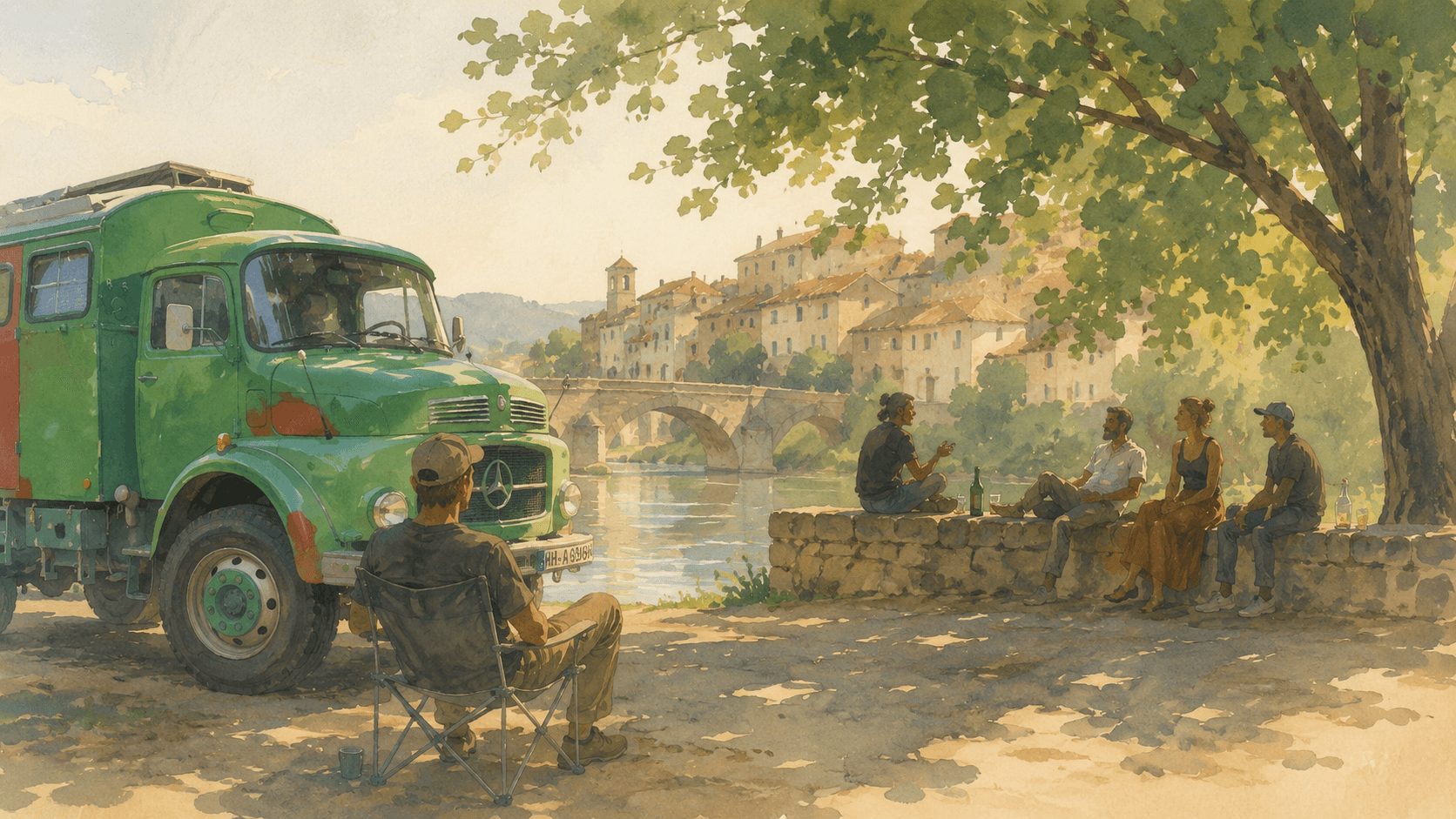
This morning, arriving in Mende, I feel something rare: the sense that I could stay here.
The river right outside the door, shade, an old stone bridge, a square within walking distance of town. Everything feels strangely right. Not in the same way the lake did, but not less so. There it was solitude, stillness, water, sunrise, nature. Here it is river, bridge, shade, village, people. Not a rupture, more like a quiet change of key.
At half past eight, silence. A man from a cleaning company works a pressure washer across the small riverside square, the one that will become a stage. He blasts the stone wall, the ground, the area under the hazel bush, as though the municipality resets the public living room to zero every morning before business begins.
Around ten, the first man arrives. He is older, carries a stick that looks like a divining rod. He seems to use it to read not only the ground but the river, the bank, the air. He sits for a while, an hour maybe, then disappears. After that, the others trickle in one by one. The way you seep into village life: one person sits, one stands, two greet each other, someone brings music, someone makes a phone call, someone lies down for a moment, someone suddenly dances.
By now I understand: this is a regular gathering, not an accident. A stone wall with two small wooden benches bolted to it. A bin. Shade. The river. A toilet somewhere nearby. Apparently that is all an open-air pub in Mende requires.
My first thought: great, I am parked directly in front of a drinking spot.
My second thought arrives more slowly: maybe this, after all, is the story.
The main character has been here since eleven. He arrived shortly after the man with the divining rod left. Tall, wiry, talks and laughs and gestures the whole time, a steady stream of phone calls. Thin as a racing cyclist, with prominent upper teeth, a silver chain, a decent watch, tracksuit bottoms, muscle shirt. The kind of man who looks like he has three lives already behind him and still carries himself as though the fourth is about to start. At some point his counterpart arrives, or his spiritual brother, nearly the same energy, nearly the same wiriness, just differently packaged: Hawaiian shirt, shorts, Ray-Ban aviators, very white teeth, cool earrings, white trainers. He too speaks with his whole body. Whether the two are arguing, teasing, winding each other up, or simply playing their roles at high volume is hard to say. Probably all of it at once.
Then there is the quieter one, who stays with me for that reason. Slightly older, tracksuit, blue t-shirt, at some point a heated phone call, the kind that sounds like equal parts frustration and powerlessness, probably with some authority. Later he lies down on the bench as if the afternoon has already used him up.
And there is the woman who reads immediately as the centre of the whole thing. Mid-thirties, hippie dress, tattoos, a few words of German, an almost maternal quality. She imposes nothing on anyone. She simply gets along with everyone. She moves between the groups, friendly, attentive, maintaining the connections without making a point of it. By now she is properly drunk, and even in that there is nothing aggressive. Something soft, frayed, human.
A shorter, stocky man with an almost-shaved head and a yin-yang tattoo on his arm. A tall Black man with sunglasses who arrives later and immediately brings more laughter into the circle. The joker. The dancer. The one who turns a gathering into a scene. Since he showed up, people laugh more. He clowns around, dances, plays with the others, and for a moment the whole thing has something of the Elbschlosskeller on a bright afternoon, except without the neighbourhood, without the Hamburger Berg, without the latent aggression I know from those places. The Elbschlosskeller in a peaceful parallel version.
What unsettles and moves me about this scene is not the alcohol, not the weed, not the volume. The level rises. Things get louder, more erratic, more dancey, more blurred. The energy is almost tender. They greet each other warmly, say bonjour, hand things around, make room, listen, laugh, and the whole time nobody feels they need to dominate or threaten the space. Nobody registers me as an intrusion. And I, which surprises me, do not register them as one either.
That is the actual reason I want to write about this.
This is not romantic. It does not smell of lavender. It smells of public space, beer cans, weed, sweat, village, broken biographies, and long days with nowhere else to be. What moves me is that underneath all of it something shows up I did not expect. A kind of mildness. A frayed, slightly drunken tenderness.
It moves me also because I know places like this. I have sat in enough of them myself. As a punk, with my own history, my own falls, my own damage. The energy then was harder, colder, more often turned against the world and against each other. So I sit here in my green truck by the river in Mende and notice something in me opening toward recognition rather than distance. The sense of: I know this ground.
It is four in the afternoon and the open-air pub under the hazel bush is in full swing. The level is up. Dancing, phone calls, laughter. Someone lies on the bench. The woman holds the centre together. The thin man still talks. French hip-hop thumps from a JBL speaker wedged into the corner of the wall.
I sit eight metres away, in my Decathlon chair, leaning against Haubi's rear right tyre, watching as this place, of all places, gets me writing.
Though "watching" is almost too simple a word for it. I am not outside this scene. I am part of it. Not in the middle of the circle, no beer can or joint in hand, but visible, present, here for hours. They see me the way I see them. Several times they have spoken to me, drawn me in, included me. Then they let me alone again. I let them alone too. There is something strange and good in that: I am neither voyeur nor participant in the strict sense, but somewhere between. Inside, and slightly offset.
The scene resists clean categorisation, and that is exactly what keeps me here. Funny? Sad? Unsettling? Inviting? The young man in the tracksuit on the bench to the right looks, in one moment, almost profoundly sad, even while sitting in the middle of it all. In the next, someone dances, everyone laughs, and the whole thing tips back into something almost light. Not beautiful in any romantic sense. Not idyllic. And not simply squalid or unpleasant either. More like an image a painter would want to fix on canvas precisely because no one could quite say what they were looking at.
What holds me here is this strange mix: weight and warmth, intoxication and courtesy, lives gone adrift and people still turned toward one another. I drink nothing, smoke nothing, and I am not simply a spectator. I sit inside the picture. Between trees, river, bridge, and the houses along the road, where somewhere on the other side of the river a window slides open and shut. A seeming idyll, an almost banal ordinariness, and in the middle of it these human lives that refuse to be sorted away, because in the end they touch something that also has to do with me.
Because they remind me that people do not sort as cleanly as we would prefer. Into retreat and problem zone. Into trouble and beauty. Into stranded lives over there and me over here. Because this small stone wall by the river is not just an open-air pub today, but a whole little world exposing itself in plain sight. On belonging, habituation, neglect, courtesy, alcohol, village life, and what happens when you do not look away.
When you hold the scene long enough, instead of skimming it and walking on. When you stay with it instead of filing it. Long enough for it to stop being scenery. Long enough for the others to stop being simply the others. And to become something of me. Of all of us. Of everything we prefer to keep at a distance by keeping it in other people's bodies and biographies, where it is easier to observe.
This afternoon moves me because it makes the boundary porous rather than confirming it. Between the people on the stone wall and me in my Decathlon chair. Between idyll and neglect. Between the ordinary and the fall. Between watching and belonging. I do not sit outside the picture. I sit inside it. And the longer I look, the less I can claim it has nothing to do with me.
I keep thinking of a line by Nisargadatta Maharaj: To know that I am nothing is wisdom. To know that I am everything is love.
What touches me here by the river in Mende is this: not that I have suddenly become one of them, or they of me. But that for a moment the whole tidy sorting collapses. I am not looking at a group of stranded people. I am looking at something human that I recognise. And I stay seated long enough to let it in, not just see it.