Stay Here Now
June 12, 2026
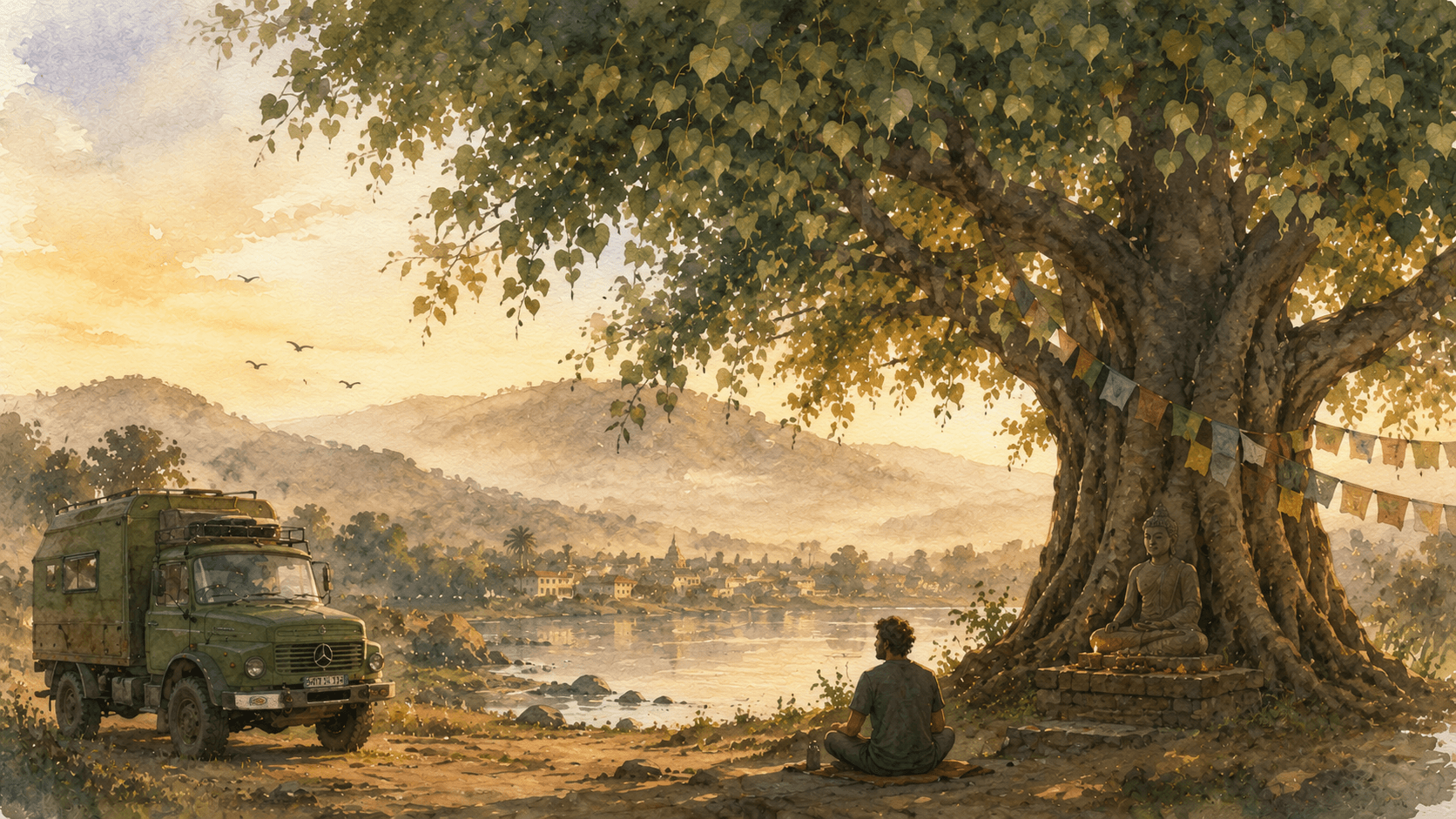
Six seventeen at the Lac de la Somme, and the water lies there like something poured. No wind. No bird with any urgency. I sit in the Haubi, the cup still warm in my hand, and the first question of the day is already here before I am properly awake: Do I sell the Haubi, or do I keep it? Right behind it, the second: Where now, and do I even keep going?
Both questions arrive too early. The viewing is scheduled for Sunday or Monday, and nothing about the situation changes before then. Still, they stand there, first thing in the morning, like two guests who show up before the door is properly open.
I let them stand for a while and look more closely. And underneath both of them lies a third question, larger than the two combined: What do I do with my time? Above all here, in the Haubi. Maybe it is not about selling or driving on at all. Maybe it is about happiness and suffering. About emptiness and patience. Themes as old as the first monks who sat down under a tree and simply stayed.
Yesterday evening, just before sleep, I listened to a talk on patience by Oliver Petersen. Words about patience, right before the day closes, and this morning that is precisely the task in front of me. Not as a resolution. As a fact.
Because something deep is making itself known right now, and it comes through the staying. Through being here, at the lake, with no plan for the next step. A small inner fidgeter moves closer, the one who would rather already be somewhere else, who already wants to see the next road, the next place, the next decision. I watch him. He sits there, fidgets a little, and I let him fidget.
Ramana Maharshi barely spoke at all. He sat. In silence. Permanently. Monks occupy themselves above all with the mind, not the next destination on the map. Here at the lake it becomes clear to me what a challenge that actually is: simply holding this silence, with nothing but myself and the water and a few birds calling somewhere in the distance. Everything around me grows slower. Noticeably slower. And the question What actually matters takes on a completely different weight when there is no urgency to answer it.
Can I simply be here? That is the real practice. And: can I recognize condensation, this tightening, this pressing quality, the moment it appears, without immediately doing something about it? Right now, for instance. There is a condensation. I see it. And that is enough.
This takes me back to my time in Portugal, at Monte Sobreiro. My hill, completely alone. Silence so complete it almost had a sound of its own. At some point I had to move on, with the truck, back onto the road. And now I sit here again, at another lake, in another country, and life places me in the same spot: in the silence, in nature, in this solitude that feels like an invitation. The invitation says: Stay here now. Like Buddha under the Bodhi tree.
The place it points to is on no map. It is a place inside me.
Because close, the word that has been with me for weeks, means something other than I thought for a long time. It does not mean that one day there will be a point where I am there, arrived, finished. Close means: let everything that wants to dissolve, dissolve. And give what is happening right now a hundred percent of my attention. This moment, at the lake, with the cup in my hand. This exact one.
Perhaps that is why it is so hard to explain, because it is so hard to convey. At the same time a longing grows louder the longer I sit by the water: simply to stand somewhere in the middle of nowhere and be. Like right now. And leave everything else to life, to the details that sort themselves out when you let them. I need little. Writing, walking, eating, drinking, sleeping. And encounters, when they come. When they do not come, they do not come.
Space exists everywhere, plenty of it. Spain, Portugal, France, Morocco. Vietnam, Thailand, Laos. Asia is perhaps where I would be most drawn to a hut, somewhere in nature. Still. Solitary. Observing, writing, reading, exploring the nature of things. Instagram and websites only when something genuinely wants to be shared, something that arises of itself.
The longer I let this sit here, at the Lac de la Somme, the clearer it becomes what a gift this is: to genuinely be able to be still. The capacity for stillness is one thing. Recognizing it as the greatest thing there is. That is something else. Everything is already here. I do not need to question it further.
From this perspective I see: life has placed me at this exact spot again and again. The spot where life was simple. Simple, without further label. I was the one who made it complicated.
The truly interesting question, then, is not about selling or driving on. It lives here: What actually happens when there is nothing left that has to happen? When there is only you and the silence, not for half an hour on a cushion, then back into the noise. But always. Twenty-four hours, seven days.
Against that background, OUTJOY remains an important place for me. A lighthouse, the image is already in the header. I am here when someone needs me. Freestyle. Less coach in any formal sense, more a mirror. And when something wants to happen, it happens, one way or another.
That is what close actually means. Close to the question: What is actually missing? Snail. Slowness. Sinking. Out there, in the end, nothing stays that brings happiness or fulfilment, nothing you could hold. The actual source lies deeper, where movement simply happens. Without ground. Without purpose. Without goal, without agenda. Simply because movement is the nature of life. Meaningless and completely complete, both at once. Permanent.
And with that view I return to my starting question. Sell the Haubi or not. Where to drive. It feels like a fork in the road with several paths leading somewhere, and yet every path lands again at the same point. I do not have to take any of them. Staying is enough. The paths come to me.
It has always been this way. Everything that truly counted came to me; none of it was plannable, none of it was a goal I worked toward. Even the greatest guru careers land somewhere eventually, and then the game begins again from the start: new paths appear, new possibilities, the next question of where next. There is no destination. You are already there. The mind simply says: This cannot be so simple.
Only in depth, in slowness, in slow motion, do things truly unfold. Only there does it show what something is worth, how intense it is, how full. Perhaps that is what is meant when people speak of patience: with patience, everything becomes very, very slow.
And what happens when everything grows slow? The opposite of what is visible everywhere right now. Reels, Shorts, AI: faster, faster, faster. But around the lake I see little that is genuinely fast. In theory, yes, a stone falling from the sky is fast. But the sun rises slowly. The moon moves in its own time. The breath, examined closely, is also slow. Plants grow slowly. Habits change slowly.
This fits the image of the paths leading away from the fork. They seem to go somewhere, and in the end you land again at a fork, exactly where you already were once. Like a matrix in which you always arrive at the same point.
The water at the Lac de la Somme still lies there, poured out, without hurry. The cup is empty by now. And the question the day began with stands no longer as a question; it simply sits with me at the bank, waiting for me to stand up. Or to stay.