Nine Times Through France, Once in France
June 6, 2026
A drop hangs on the wire fence. Outside it is grey, fifteen degrees, a fine drizzle sitting over Rodemack, and the heating is running again. Middle of June. The high-pressure system has shifted. The drop just sits there. Round, heavy, complete in itself. Patient. It waits for the moment that is already on its way. It is just past five in the morning, the dreams of the night still present: murder, theft, prison — everything that wants to be processed. And still, attention keeps returning to something underneath all of it: I am. Simply that. Clean. The dreams have a different quality than before: attention stays with what is there.
The water lily opens when the conditions are right. That is the first image this morning, arriving while I still lie in the dark. The water lily follows a knowing that sits deeper than any decision. It opens because the moment is ripe: finished, complete, ready. I let it be there: this image, the drop on the fence, the still-heavy mood of the night, the grey sky behind it, the heating working steadily. I notice that something in me has stopped needing to resolve it immediately, even though I could — the open question, the restlessness, the dreams, the question of what comes next. That is new. That is the newest thing this summer has brought so far:
Can I watch what is becoming, while it is becoming?
By midday the sky has barely changed. Washing, a ten-kilometre drive to the next village, then to Lidl, then a coffee. That is exactly what I had planned for this morning, and that is what happened. On the way back to Haubi I sit for a moment, drink the coffee and simply watch what occurs. I notice: the chest is quiet. There is the grey and the rain and the unfinished day, and at the same time there is this quiet surface underneath. France used to be the stretch between Germany and Portugal. The transit corridor you moved through as efficiently as possible, because the destination was already waiting at the Algarve or somewhere in southwest Portugal. Four in the morning, coffee in a thermos, engine on, then nine hours straight — eight, nine times this route, ten times perhaps — and France was the road between where I was and where I was going. The body sat in the driver's seat. The mind was already elsewhere. Mostly, anyway.
Today something else happens. The feeling arrives quietly, almost in passing: back to Rodemack has the weight of someone else's suggestion. South is the right direction. A sensation. That is all. Open terrain, open next step, a quiet inner movement that feels like the obvious thing. I set off around midday. This is the first time in nine years I have left like this: around midday, slowly, the road the only thing that counts. It was always early, always fast, always a destination already doing the counting. Now the A31 lies ahead, towards Toul, then the D94 towards Neufchâteau, and the landscape grows wider, quieter, the sun appearing between the hills of the Haute-Marne, and I simply drive until something says: here.
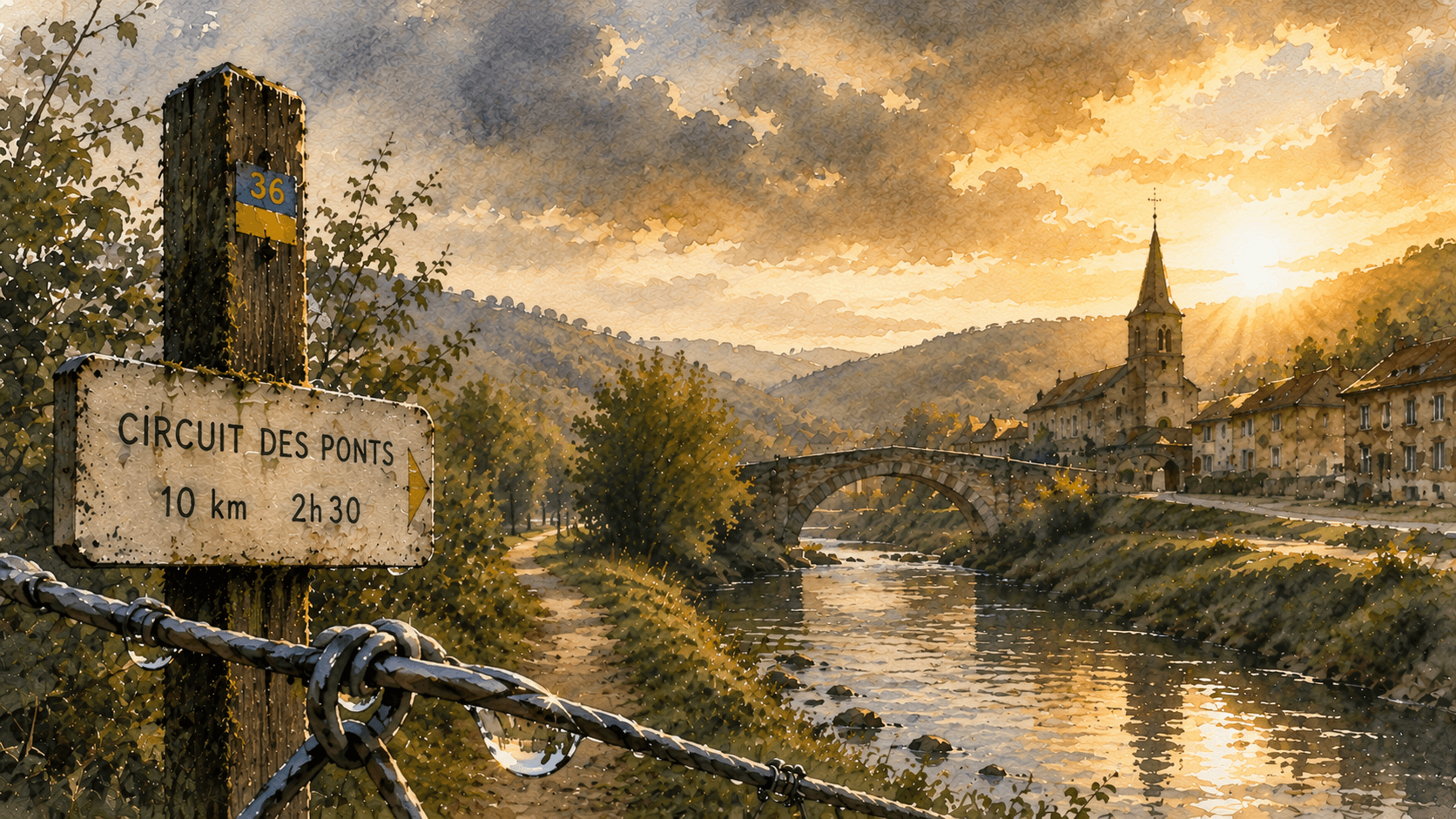
Goncourt. A church, a bridge, a stream, a tabac. That is all the map shows, and it is accurate. Somewhere here by this small stretch of water that calls itself the Meuse before it grows large, Haubi finds a spot in the sun, and when I step out it is immediately there: warmth on the skin, light on the water, a silence that feels right — the kind of silence you recognise the moment you are inside it. I walk through the village. Very, very little: a tabac with beer on tap where a man is enjoying what is clearly a well-earned end-of-day drink, the path along the stream with old stones. Completely right. A German woman comes along the path with a dog — the dog sniffing, she smiling. You can walk beautifully here, she says, and gestures roughly in one direction, because the direction is obvious when you are standing by a stream. I say thank you. Then I find the sign.
Circuit des Ponts. 10 km. 2h 30.
I set off on the spot. The way the whole day is on the spot.
First along the stream, the water slow and clear, then along the railway line, the valley wide and open, sunlight on the gravel. Left and right the hills and wooded terrain extend. The trail markers appear: number 36, blue and yellow, on posts, on stone walls, always at the moment you begin to doubt the last direction. One after another. Then the fork arrives, and the sign points left and up, out of the valley and into the forest. The first hundred metres steep, the ground wet from rain, then the forest opens: old beeches, mossy stones, light working through the canopy, a floor of years upon years of fallen leaves that yields softly underfoot. Very quiet here. The kind of silence in which you hear your own breath, your steps, the forest.
Then on the ridge the markers stop. The route had walkers going the other way in mind, and my direction is on its own from here. This is terrain. I check my position on Organic Maps, read the topography, look for the catch line — that is the first thing you learn in the wild: find the terrain feature that holds you when all the markers are gone. The next road lies to the west. The valley to the east. Organic Maps, dotted lines, manageable scale. On the Jordan Trail this was everyday life: through wadis with a compass, on stretches where the promised signage turned out to be a rumour, five days through the southern desert with GPS and the next perceptible step. This is different terrain. Readable on its own terms. I orient myself. Attention stays quiet and alert, the way forward open.
And then, in a small hollow, a handmade construction of stones and wood, and beside it a sign: Source de la Louvière. A spring, directly from the ground. The water is cold, genuinely cold, and I drink, stand there a while, the cool forest around me, the water on my tongue. This spring simply appears. In the middle of the forest. With a sign.
While I pause a moment later to look at an old stone and wonder how it came to be here and what its history is — a deer, ten metres ahead. It stands briefly, looks, crosses the path and is gone. I stay still. Then on. Wild boar tracks everywhere, the ground churned up left and right. Fresh — that was last night. Tall grass, fallen trees, a field at the edge of the forest, then a barbed-wire fence running across the terrain. I walk parallel to it, thirty metres, forty, until the gap comes, and push through. The calves catch the bottom wire. And then: the railway line. The same gravel, the same rails I set off along earlier. Now from the other side, the village in sight, Haubi where I left him. The circle closes.
Ten kilometres on the clock. With the ascents and the cross-country section it will be a little over ten in the end. I am tired and very satisfied — the only right combination after an evening like this. The calves show traces of the last metres through the undergrowth. Haubi stands in the last sun, the summer moving through the valley, and I sit outside, legs stretched out, let the silence arrive.
This Friday still had the face of an empty day this morning: washing, shopping, open terrain. A day that holds what it is until it shows itself. And then it unfolded: Goncourt appeared as the next step, from the single logic of the direction that felt right. The walking route stood on a sign and waited for someone who stops. The spring lay along the path, cold and unannounced. The deer was simply there. The detour through the undergrowth was orientation under different conditions: stayed with it, held the inner centre. Each of these things arose from the one before. Everything from the moment, each one always already the material for the next.
That is the connection to the morning that I see now. The drop on the wire fence, hanging quietly, waiting for its moment. The water lily opening because the conditions are right. All of it from a movement that sits deeper than determination or speed, deeper than any travel plan. On nine drives through France that was invisible. Because the mind was already elsewhere, already in the next chapter, already at the arrival that counted, and France in between simply vanished. Today I was in Goncourt. In this small village that earns only a dot on most maps, that has a church and a tabac and a walking route that takes you up from the valley into the forest, through beeches and mossy stones and a named spring that gives cold water directly from the ground.
The drop falls when it is ready. That is the sentence this day began with. I held it in the morning as an image, as a question, as something on a trail that reveals itself while you walk. Now, in the evening, with tired legs and the last daylight on my face, I have the feeling that the day lived this question — step by step, from the heating in Rodemack to the barbed-wire fence above the field near Goncourt, the direction each time arising from the previous moment, the whole thing out of itself.
There is something here that can be described, and there is something here that slips past description. That is what is beautiful about it. Nine years with Haubi. Almost always a destination. Mostly I wanted to arrive somewhere. And this day — this quiet Friday in the Haute-Marne — is the first time France was a place.
What opens when you let go of already knowing what comes next?
Look at Goncourt.